

[ad_1]
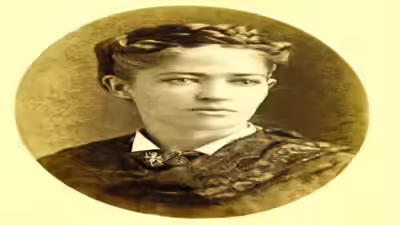
Every time you fill up gleaming dishes to place inside your cabinets and hit the switch for cleaning them, you rely on a tradition that did not originate in a laboratory of the future but in a kitchen of the nineteenth century. Our perception of devices used in the kitchen is often confined to thinking about how these tools are nothing more than innovations brought forth suddenly by some miracle of science. The dishwasher was invented out of frustration in high society. During the 1880s, Josephine Cochrane had become tired of receiving cracked and chipped dishes from the kitchen.Instead of simply complaining about the tasks that had to be done around the house, Cochrane chose to create a solution. In her well-known joke, if nobody else could come up with a washing machine, she would give it a try herself. She searched for a machine that would wash dishes faster than any human and, most importantly, without the possibility of mistakes. It is clear from her story how a simple annoyance related to home life could become a mechanical system, which later turned out to be groundbreaking for our world. The change did not happen overnight, but gradually became apparent in the way we approached home maintenance and trusted machines.Turning domestic losses into mechanical designThe route from a foamy sink to an invented patent was motivated by the special way of looking at housekeeping Cochrane had. According to the Lemelson-MIT program, Cochrane was a woman aware of the flaws of the methods common in her time. She knew that cleaning delicate items in a sink presented risks because plates inevitably collided with each other and with the sink itself. What made her invention different from other solutions was the desire to preserve the valuable plates from accidental damage.Although Cochrane did not invent the first device used for dishwashing, she proved unique in that she rejected the traditional scrubbing technique. The records available at the USPTO indicate how her innovation marked a departure from the past by completely abandoning rubbing and brushing techniques. Prior inventors had attempted machines incorporating a scrubbing brush made of wood material in an effort to mimic the action of hand rubs, with little success. Cochrane came up with the revolutionary idea of utilising water to wash dishes. Her innovation incorporates wire slots where dishes are held while jets of soap and water spray them.
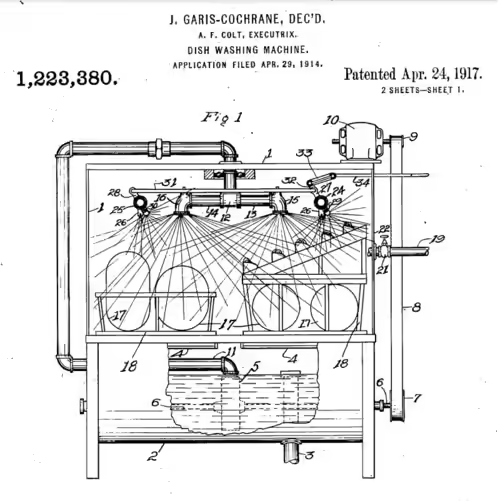
Though patented in 1886, widespread adoption took decades due to infrastructure limitations, with hotels and restaurants first benefiting from her ingenious design, fundamentally changing home maintenance. Image Credit: via Wikimedia Commons
The transition from manual cleaning to pressure cleaning was the birth of an actual engineering system. The dishwasher was now a device capable of doing a job, rather than a bizarre gadget. Although she was a socialite without any engineering knowledge, Cochran’s realisation about the “problem of hard cleaning” enabled her to design a machine which could expand beyond the kitchen in her house. This is because, in order for a machine to be useful, it needs to be more reliable than a human being.A long journey from the patent to the kitchenCochran’s innovation was genius, but it did not immediately change the world. Cochran successfully patented her automatic dishwasher on December 28, 1886. However, history proves how much time passed between the conception and application of this invention. After all, the typical household acquired its dishwasher only in the middle of the twentieth century.The reason she waited until her washing machine could be made available to the typical household was that the infrastructure did not yet exist. The plumbing of houses at this time simply did not have the heavy-duty piping or capacity to hold enough hot water to make her invention feasible. This explains why Cochrane’s success first came in hotels and restaurants, places where there were large numbers of dishes to wash.Her contributions prove the importance of a female perspective in an area dominated by men. The issue that she addressed was personal because the consequences of damaged dishware were direct and obvious. When the commercial sector eventually adopted her invention in the 1950s, the principles of engineering that she established back in 1886 still remained at the core of its structure. Cochran was not just trying to make plates clean; she demonstrated how even the most mundane domestic tasks could be redesigned using the concept of mechanical integrity. The frustration of chipped dishware eventually proved to be one of the many insignificant factors that led to the formation of today’s household environment.